
Raleigh NC Deed Records
Raleigh deed records are filed at the Wake County Register of Deeds. As the state capital and county seat, Raleigh sits at the center of one of the busiest real estate markets in North Carolina. The Wake County Register of Deeds serves as custodian for deeds, deeds of trust, subdivision plats, and other real estate instruments. The office is located at the Wake County Justice Center, 300 S. Salisbury St., Suite 1700, Raleigh, NC 27601. All property transfers within Raleigh pass through this office.
Raleigh Deed Records Quick Facts
Raleigh Deed Records Office
The Wake County Register of Deeds handles all Raleigh deed records. The office launched new land records software recently, which upgraded the way documents are filed and searched. The Register of Deeds is governed by North Carolina General Statutes and serves as the official keeper of real estate transactions, birth and death certificates, marriage licenses, notary public oaths, and DD-214 military discharge papers.
For Raleigh deed records, the real estate division is your main contact. This team processes new deed filings, handles copy requests, and maintains the index of all recorded instruments. The office is at 300 S. Salisbury St. in downtown Raleigh. Walk-in service is available during business hours. You can also mail documents for recording or use electronic filing through approved vendors.
Searching Raleigh Property Deeds
Wake County provides online search tools for Raleigh deed records. The county website lets you search by grantor, grantee, book and page, or document type. The new land records software makes searches faster and more accurate. You can trace the chain of title for any Raleigh property through these records.
The Wake County Tax Administration also holds property data that connects to Raleigh deed records. Real estate in Wake County is permanently listed, meaning you do not need to relist your property each year. The tax lien attaches on January 1 and stays until all taxes are paid. Annual tax bills go out in July. Appraisers visit properties to verify details, and these visits typically take 15 to 30 minutes.
The Raleigh Planning Department provides context for deed records through its development tracking.
The city is committed to efficient, equitable, and reasonable growth that supports economic prosperity and safety in the built environment.
Raleigh Recording Requirements
Raleigh deed records must meet state format standards before the Register of Deeds will accept them. Under G.S. 161-14, paper must be 8.5 by 11 inches or 8.5 by 14 inches. The first page needs a three-inch blank margin at the top. All other margins must be at least half an inch. Use black ink on white paper. Font size must be at least nine points. Print on one side only.
The deed must show the type of instrument at the top. It must be signed and notarized. The drafter's name must appear on the first page for deeds filed after January 1, 1980, as G.S. 47-17.1 requires. Documents that do not meet these rules can still be recorded, but you will pay a $25 nonstandard document fee in addition to the base recording charge. Meeting the format rules upfront saves money on Raleigh deed records.
North Carolina is a race to record state. Under G.S. 47-18, the first person to record a deed at the county office holds priority. An unrecorded deed is not valid against a later buyer who paid value and recorded first. After any Raleigh property closing, the deed should be filed with Wake County right away.
Raleigh Deed Fees
Recording fees for Raleigh deed records follow the statewide rates set by NCARD. The base fee for a standard deed is $26 for the first 15 pages. Each extra page costs $4. Deeds of trust and mortgages have a higher base fee of $64 for the first 35 pages, with $4 for each additional page. Plats cost $21 per sheet.
The excise tax on property sales in Raleigh is set by G.S. 105-228.30. The rate is $1 per $500 of the purchase price. The seller pays this tax to the Wake County Register of Deeds before the deed is recorded. For a $400,000 Raleigh home, the excise tax would be $800. This tax applies to all types of property transfers, including timber deeds and contracts for the sale of standing timber.
Satisfaction instruments have no recording fee. Documents that release a mortgage or lien are filed at no cost. The nonstandard document surcharge of $25 applies to any filing that does not meet format rules. Multiple instruments filed as one document cost $10 per extra instrument.
Raleigh Development and Deed Records
The Raleigh Planning Department tracks development activity that generates new deed records. Recorded maps and plats are legal instruments that show property boundaries, easements, and roads. These documents are filed at the Wake County Register of Deeds alongside deeds and deeds of trust. Rezoning cases, annexation petitions, and site reviews all can lead to new filings in the Raleigh deed records system.
Raleigh planning and development activity creates a steady flow of deed records each year.
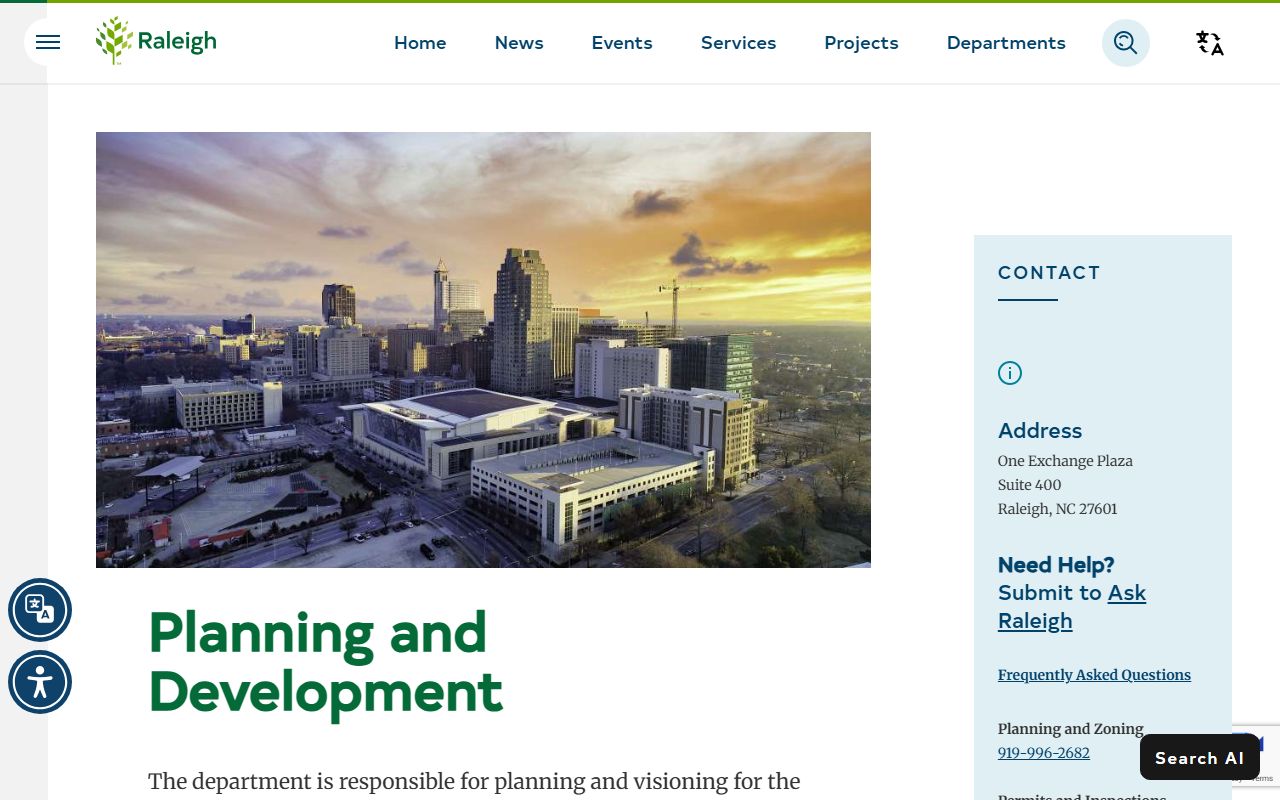
The Raleigh development tracker shows active cases including administrative site reviews, certificates of appropriateness for historic districts, and Board of Adjustment hearings.
Subdivision plats are a key part of Raleigh deed records. When a developer divides land into lots, the plat must be recorded at the Register of Deeds. Each lot then has its own legal description that comes from the plat. Future deeds for those lots reference the recorded plat by book and page. This system ties all Raleigh deed records together from the original subdivision through each subsequent sale.
Raleigh Property Tax Liens
Property taxes affect Raleigh deed records in important ways. Under G.S. 161-31, Wake County can require tax certification before recording a deed. This means the tax collector must confirm that no delinquent taxes are owed. Tax liens attach on January 1 of each year and remain until all taxes are paid in full. Properties with unpaid taxes may face tax foreclosure proceedings.
Wake County tracks foreclosure cases by Tax ID number. Each case shows the date of first action, judgment filing date, and sale date. These foreclosure actions generate their own deed records when the property is sold. A closing attorney in Raleigh can include a certification in the deed stating that any delinquent taxes will be paid from closing proceeds, which satisfies the tax certification requirement without a separate trip to the tax collector.
Electronic Recording in Raleigh
Wake County supports electronic recording for Raleigh deed records. The Uniform Real Property Electronic Recording Act, found in G.S. 47-16.1 through 47-16.7, authorizes this process. Electronic documents and signatures satisfy all recording requirements under state law. The NC Secretary of State sets standards through the Electronic Recording Council.
Electronic recording is faster and more efficient. A Raleigh deed submitted online gets recorded in minutes. The document gets the same legal weight as a paper filing. It receives a time stamp, document number, and book and page assignment. The NCARD website lists counties that support eRecording and the document types they accept. Check with the Wake County Register of Deeds for current eRecording options for Raleigh deed records.
Wake County Deed Records
All Raleigh deed records are filed and stored at the Wake County Register of Deeds. The county office serves Raleigh, Apex, Cary, and every other municipality in Wake County. For full details on office hours, recording procedures, search tools, and contact information, visit the Wake County deed records page.