
Wake County Deed Records Search
Wake County deed records track every real estate transfer in the most populated county in North Carolina. The Wake County Register of Deeds office in Raleigh serves as the custodian of these public documents. Property buyers, title companies, and attorneys use Wake County deed records to confirm ownership before any sale or loan. The office records deeds, deeds of trust, subdivision plats, and a wide range of other instruments. As the state capital county, Wake County processes a high volume of real estate filings each year. This page covers how to search, file, and understand Wake County deed records.
Wake County Deed Records Quick Facts
Wake County Register of Deeds Office
The Wake County Register of Deeds office is in the Wake County Justice Center at 300 S. Salisbury St., Suite 1700, Raleigh, NC 27601. Office hours run Monday through Friday, 8:30 AM to 5:00 PM. The office is closed on state holidays and weekends.
The Register of Deeds serves as custodian for deeds, deeds of trust, and subdivision plats. The office also issues marriage licenses and provides birth and death certificates. Staff are responsible for protecting the integrity, completeness, accuracy, and safekeeping of all public records in their care. The office operates under North Carolina General Statutes Chapter 161.
Wake County warns the public about scams. The office has posted a consumer alert about companies that charge fees for documents you can get directly from the Register of Deeds. Always go to the official source first.
Search Wake County Property Records
Wake County launched new land records software in a recent major system upgrade. The Wake County Register of Deeds website gives you access to search recorded documents. You can look up records by owner name, address, or document type.
The image below shows the Wake County property records search page.
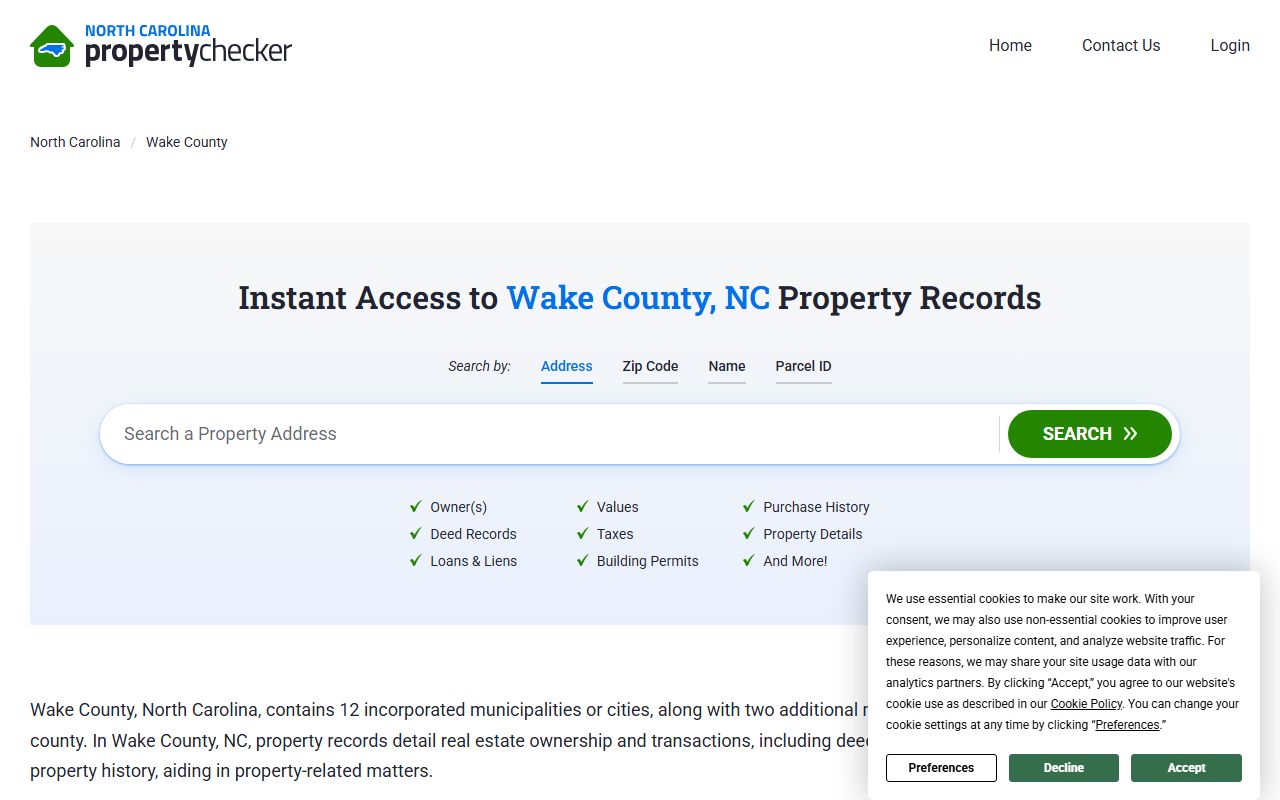
Online results are for reference. Certified copies must come from the office.
Wake County also offers iMAPS, an interactive property mapping tool. Wake County GIS and Raleigh GIS built this system together. You can look up properties by owner name, address, place of interest, or intersection. It pulls in a range of maps and property data. This tool is helpful when you need to see where a parcel sits or what lots are near it.
Wake County Real Estate Tax Records
Real estate in Wake County is permanently listed. You do not need to relist it each year. The tax lien attaches on January 1 and stays until all taxes are paid in full. Wake County Tax Administration handles property valuations and tax billing.
Property owners must report new buildings, additions, or improvements where no building permit was issued. County appraisers visit properties to verify details, take measurements, and review story heights. These visits take about 15 to 30 minutes. Annual tax bills go out in July. The fiscal tax period runs July 1 through June 30.
If taxes go unpaid past the due date, interest charges begin. The rate is 2% for January, then three-quarters of 1% each month after that. Under G.S. 161-31, a county may require tax certification before recording a deed. This means the tax collector must confirm no delinquent taxes are a lien on the property.
Recording Fees for Wake County Deeds
Wake County uses the statewide fee schedule. Under G.S. 161-10, most instruments cost $26 for the first 15 pages and $4 per additional page. Deeds of trust and mortgages cost $64 for the first 35 pages, plus $4 per page after that. Plats are $21 per sheet. Nonstandard documents carry a $25 surcharge. Satisfaction instruments have no fee.
The excise tax on conveyances applies to every property transfer in Wake County. Under G.S. 105-228.30, the rate is $1 per $500 of the sale price or any fraction of that amount. The seller pays this tax to the Register of Deeds before recording. View the full list at the NCARD recording fees page.
Wake County eRecording and Plats
Wake County began accepting eRecording on September 1, 2021. This allows attorneys, title companies, and lenders to submit documents online. Electronic plat and subdivision maps can also be recorded this way. The process follows the Uniform Real Property Electronic Recording Act in G.S. 47-16.1 through 47-16.7.
The image below shows the Wake County real estate records system.
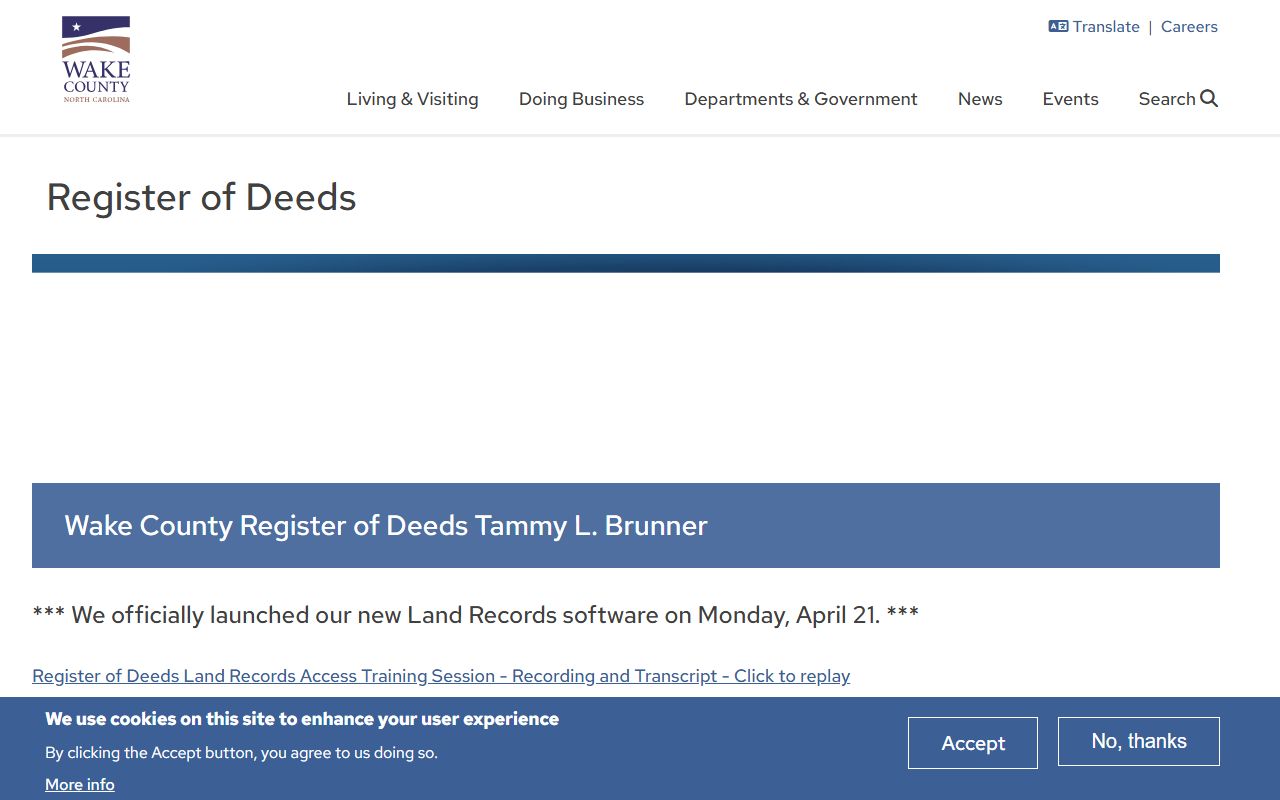
Electronic documents must meet the same formatting standards as paper ones. The Secretary of State sets the rules for electronic recording across North Carolina. An electronic signature has the same legal weight as a pen signature.
Filing a Deed in Wake County
Before filing, make sure your deed is signed and notarized. The grantor must sign. A notary or authorized officer must acknowledge the signature under G.S. 47-14. The document must meet all format rules under G.S. 161-14. Paper must be 8.5 by 11 inches or 8.5 by 14 inches with a 3-inch top margin on the first page.
Bring the deed to 300 S. Salisbury St. in Raleigh. Pay the fees. The register stamps the document with the date and time of filing. The deed is then indexed by grantor and grantee names. Under G.S. 47-18, North Carolina is a race to record state. The first party to record has priority. File your deed quickly after closing to protect your interest.
Wake County Records and State Resources
The NCARD directory lists Wake County along with all 99 other counties. The North Carolina Association of Registers of Deeds serves every county office in the state. It provides guidance on fees, standards, and best practices.
The image below shows the NCARD website that serves all 100 North Carolina counties.
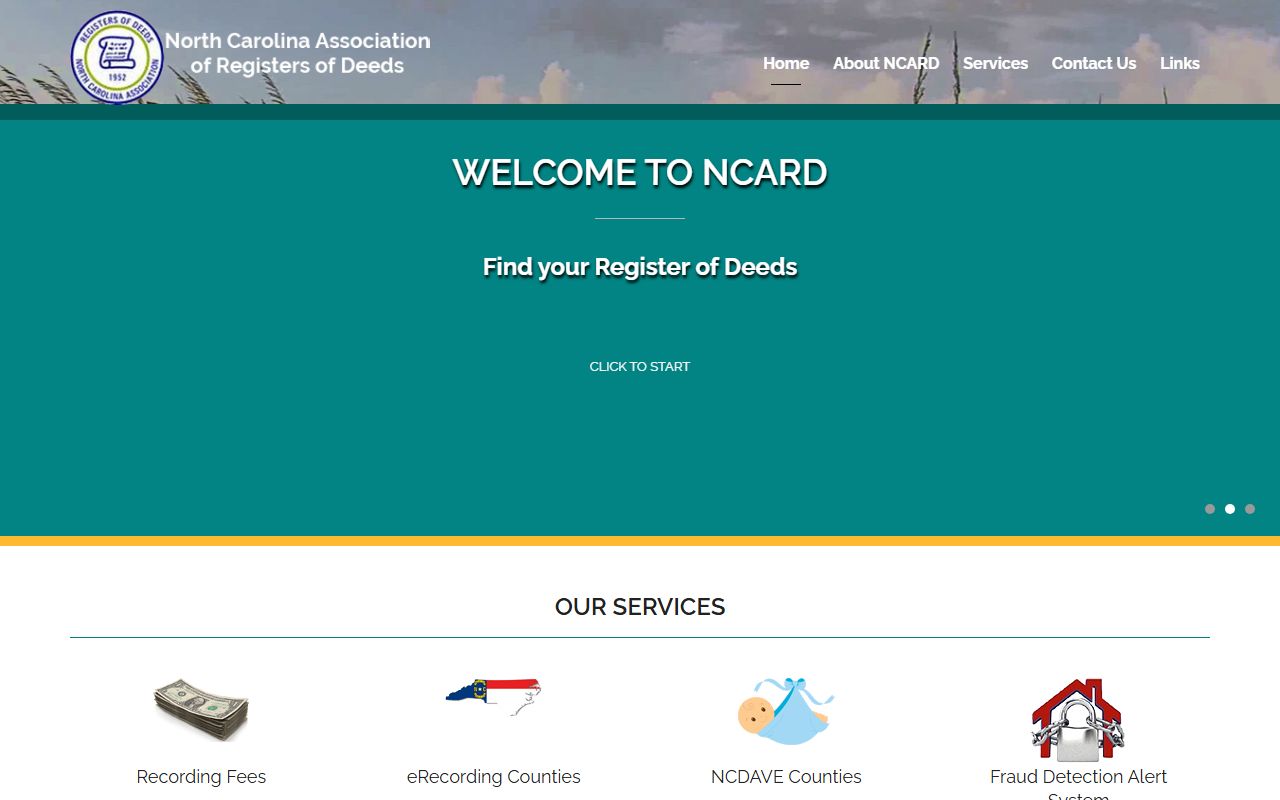
NCARD also tracks which counties offer eRecording, eBirth registration, and property fraud alerts. Wake County supports all three services. Use the state resources along with the county office to get a full picture of any property record.
Nearby Counties
Property near Wake County borders may be recorded in one of these neighboring counties.