
Surry County Deed Records Search
Surry County was formed in 1771 from Rowan County. Its county seat is Dobson. Land records in this county span more than 250 years, making it one of the richest archives in North Carolina. The Register of Deeds office keeps deeds, trust deeds, plats, mortgages, and vital records. Birth and death files start in 1913, while marriage records go back to the county's founding in 1771. No known courthouse fire has damaged these records, so the chain of title is complete. This guide covers how to access and use Surry County deed records.
Surry County Deed Records Quick Facts
Surry County Register of Deeds
The Surry County Register of Deeds office is in Dobson. It handles all land recordings for the county. Staff file deeds, deeds of trust, mortgages, plats, UCCs, and vital records. The office serves walk-in visitors during business hours.
You can find the office contact details through the NCARD county directory. That page lists the address, phone number, and website for every Register of Deeds in North Carolina. Surry County is included.
The office has no known gaps in its records. Because no courthouse disaster has struck Surry County, the deed books form an unbroken chain back to 1771.
Online Deed Search for Surry County
Surry County offers online property records searching. The tool lets you look up deeds by name, date, or reference number. Results are free to view.
Online results work well for quick checks. They show the document type, date, and book and page numbers. But online copies are unofficial. For legal work, get a certified copy from the register. Certified copies cost $5 for the first page and $2 for each page after that.
Surry County Deed Recording Fees
Fees in Surry County match the statewide rates under G.S. 161-10. Recording a standard deed costs $26 for the first 15 pages and $4 per extra page. Trust deeds and mortgages are $64 for the first 35 pages, then $4 per added page. Plats are $21 per sheet.
Documents that fail to meet format standards get a $25 nonstandard surcharge. Satisfaction instruments are free to file. The NCARD recording fees page has the full schedule.
Filing Deeds in Surry County
To file a deed in Surry County, it must be signed and notarized. Under Chapter 47 of the General Statutes, every deed must be acknowledged by the grantor before it can be recorded. The drafter's name must appear on the first page for any deed made after January 1, 1980.
The document must follow the format rules in G.S. 161-14. Use 8.5 by 11 or 8.5 by 14 inch white paper. Print in black ink with a font of at least 9 points. Leave a 3-inch margin at the top of page one and half-inch margins on all other sides. Print on one side only.
Here is a view of the NCARD recording fee schedule that applies to Surry County and all other counties in the state.
View the North Carolina recording fee schedule for current rates.
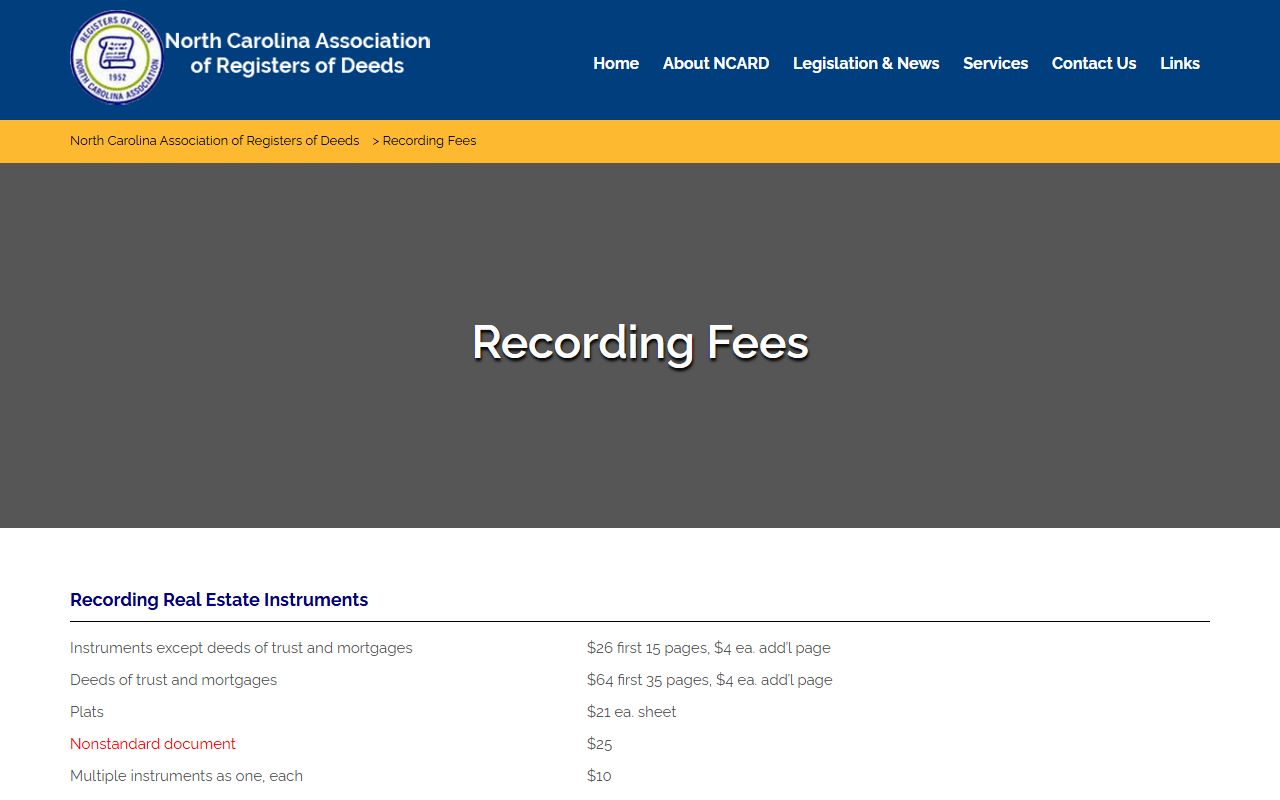
This fee list covers deeds, trust deeds, plats, and all other document types filed at the county level.
Surry County Property Transfers
North Carolina is a race-to-record state. The Conner Act (G.S. 47-18) says a deed is not valid against other buyers or creditors until it is recorded. The first person to file wins the priority race.
This rule applies to every transfer in Surry County. Record your deed as soon as it is signed and notarized. The register stamps the date and hour on the document. That time stamp sets your place in line. If two deeds arrive at the same time, the one with the lower document number takes priority.
Surry County Excise Tax
The state excise tax on property transfers is $1 for each $500 of the sale price. This is set by G.S. 105-228.30. The seller pays the tax to the Register of Deeds before the deed is recorded. At the median home value of $145,600, the tax comes to about $292.
The excise stamp on a deed is public. It gives researchers a way to estimate sale prices when the deed does not state the amount paid.
Surry County Title Research
Title searches in Surry County benefit from the complete record. With no courthouse fire in the county's history, the deed books stretch back to 1771 without gaps. Attorneys and title companies follow the grantor-grantee index to trace ownership from one party to the next.
The Register of Deeds maintains alphabetical indexes as required by G.S. 161-22. These indexes cover every recorded instrument. Cross-indexing ensures that all parties to a deed show up in the records. The North Carolina Association of Registers of Deeds promotes uniform indexing across all 100 counties.
County commissioners may also require tax certification before a deed is accepted. Under G.S. 161-31, the tax collector must confirm no delinquent taxes exist on the property. A closing attorney can satisfy this rule by adding a statement to the deed.
Surry County Deed Records Image
Below is a look at Surry County property records information and deed filing resources.
Use the county's online search tool or visit the office in Dobson for help with your property research.
Surry County eRecording
Surry County supports electronic recording. Attorneys and title firms can submit documents online instead of traveling to Dobson. The Uniform Real Property Electronic Recording Act in G.S. 47-16.1 through 47-16.7 governs this process. Electronic signatures have the same legal effect as ink signatures.
The NC Secretary of State sets standards for eRecording across the state. The NCARD directory lists which counties accept electronic filings. All electronic documents must follow the same format rules as paper filings.
Nearby Counties
Surry County shares borders with several other counties. If your property sits near the line, check these offices too.