
Pitt County Deed Record Search
Pitt County deed records date back to 1760, the year the county was established. The Register of Deeds in Greenville serves as the official custodian of all property records. Lisa P. Nichols leads the office. Records include deeds, mortgages, liens, plats, condominium declarations, foreclosure documents, tax liens, and judgments. The office maintains these records in perpetuity with comprehensive preservation measures. Free public access terminals are available at the office for anyone who wants to search Pitt County deed records in person.
Pitt County Deed Records Quick Facts
Pitt County Register of Deeds Office
The Pitt County Register of Deeds is at 1717 W. 5th Street, Greenville, NC 27834. The public counter is open Monday through Friday, 8:00 AM to 5:00 PM. Call (252) 902-1900 for help with deed records or general questions.
Lisa P. Nichols serves as Register of Deeds. The office records deeds, deeds of trust, mortgages, plats, liens, and many other real estate instruments. It also issues marriage licenses and handles vital records. All documents filed in the office become part of the permanent public record for Pitt County. Staff can help you search by name, book and page, property address, or document type.
The Pitt County property records portal shown below provides an overview of all record types available in the county.
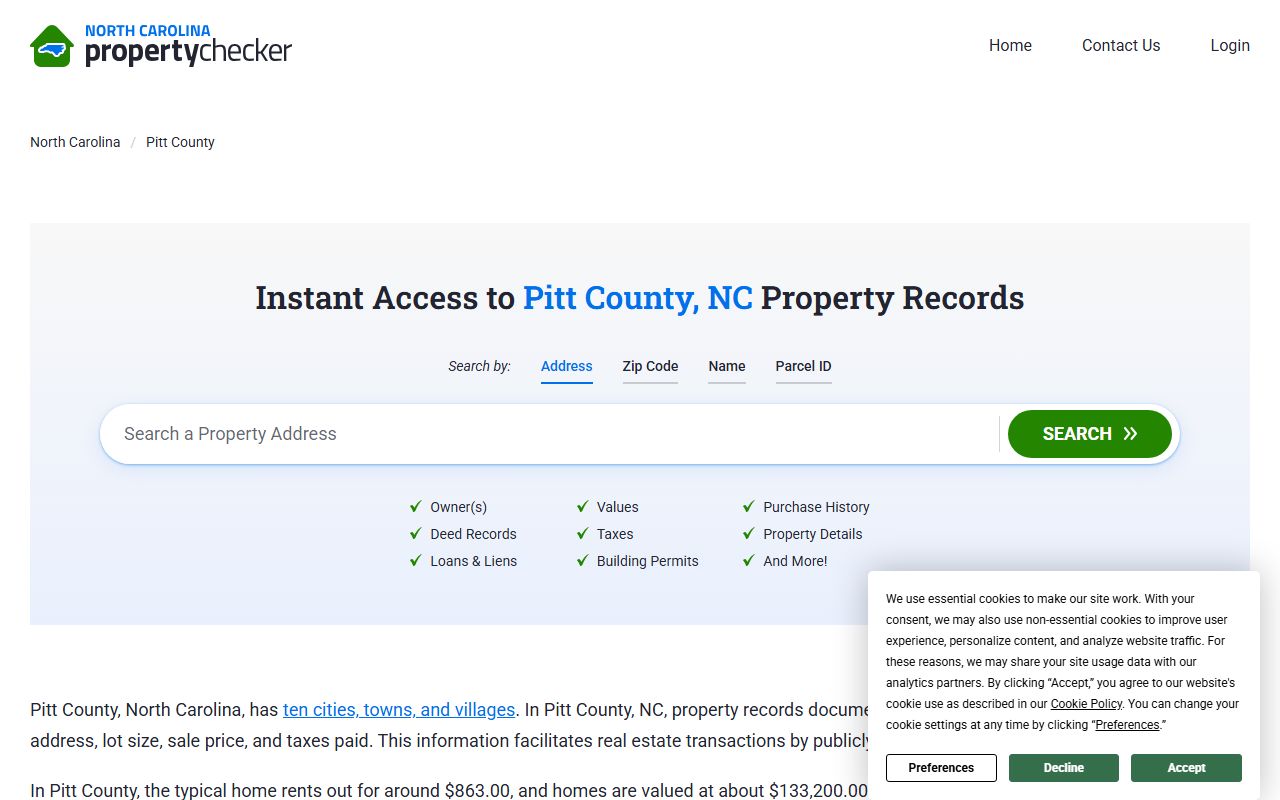
This portal describes search options and links to the online record lookup system.
Searching Pitt County Deed Records Online
Pitt County offers a robust online search portal for deed records. The system supports several search methods:
- Name search by grantor or grantee
- Property address lookup
- Book and page number
- Document type filter
- Recording date range
The Pitt County eSearch portal provides online access to real estate records. Some advanced features require a login account. Basic searches are available to all users without registration. The system covers records from the earliest filings to the present day.
Pitt County also offers the OPIS system. This Online Parcel Information System uses a GIS interface to show property boundaries and parcel information. It can be useful when you know a property location but not the owner's name or deed book number.
Free access terminals are set up at the Register of Deeds office for walk-in users. The online system runs around the clock for remote searches.
Recording Deeds in Pitt County
To record a deed in Pitt County, your document must meet state formatting rules. Under G.S. 161-14, paper must be 8.5 by 11 inches or 8.5 by 14 inches. The first page needs a three-inch top margin. All other margins must be at least half an inch. Use black ink on white paper. The font must be 9 points or larger. Print on one side of each page.
Recording fees in Pitt County follow the schedule set by G.S. Chapter 161. Standard deeds cost $26 for the first 15 pages, plus $4 per extra page. Deeds of trust and mortgages cost $64 for the first 35 pages. Nonstandard documents add $25. Satisfaction instruments have no fee. The NCARD recording fees page has the full list.
Pitt County Deed Priority
North Carolina follows a race to record rule. Under the Conner Act, G.S. 47-18, the first person to record a deed at the Pitt County Register of Deeds is the legal owner. Priority is set by the time the document is presented. The office stamps each instrument with the day and hour it arrives.
If two instruments are filed at the same time, the one with the earlier document number takes priority. This system provides a clear order of title for all land in Pitt County. Prompt recording is the best way to protect your rights.
Excise Tax on Pitt County Transfers
An excise tax applies when real property is transferred in Pitt County. Under G.S. 105-228.30, the rate is $1 for every $500 of the sale price or any fraction of that amount. The seller pays this tax to the Pitt County Register of Deeds before the deed is recorded.
The tax also applies to timber deeds and contracts for standing timber. If a parcel lies in two or more counties, the tax goes to the county with the greater share of value. Excise tax stamps appear on the recorded document for anyone to view.
Pitt County Document Standards
Under G.S. Chapter 47, each deed filed in Pitt County must be signed and acknowledged before a qualified officer. The drafter's name must appear on the first page for any deed executed after January 1, 1980. The type of instrument must be stated at the top of page one so the Register of Deeds can classify and index the document correctly.
Pitt County follows the minimum indexing standards adopted by the Department of the Secretary of State. Names appear on the index as they are shown on the original instruments. The NC Secretary of State oversees the Electronic Recording Council, which sets eRecording standards for the state. Many counties now accept electronic documents. Contact the Pitt County office to confirm which document types can be submitted electronically.
The statewide recording standards page at NCARD lists all format and indexing rules that apply across North Carolina.
Pitt County Historical Deed Records
Pitt County was established in 1760. Its deed records span more than 260 years. Early records include handwritten deeds, land grants, and surveys. These documents can be hard to read due to old handwriting styles and faded ink. The Register of Deeds office has preservation measures in place to protect these historical records.
Researchers tracing title chains or family history can search older records through the online portal or visit the office. The NCARD directory lists all 100 North Carolina county Registers of Deeds and can help if your search leads to neighboring counties like Beaufort, Greene, or Lenoir.
Nearby Counties
These counties surround Pitt County. Their deed records may be useful for cross-county property or title searches.