
Iredell County Deed and Land Records
Iredell County deed records document land ownership in the Statesville and Mooresville areas from 1788 to the present. The Iredell County Register of Deeds maintains all property filings at the Hall of Justice Annex on East Water Street in Statesville. Incorporated on November 3, 1788, from Rowan County, Iredell County has a long history of recorded land transactions. Property buyers, attorneys, and title companies rely on Iredell County deed records to verify ownership. The county also keeps birth records from 1913 and marriage records from 1869. This guide explains how to search and use these records.
Iredell County Deed Records Quick Facts
Iredell County Register of Deeds
The Iredell County Register of Deeds sits at 201 E. Water Street, Box 904, Statesville, NC 28677. The phone number is 704-872-7468. The office is in the Iredell County Hall of Justice Annex. Staff handle deed recordings, copy requests, and document searches during regular business hours.
Iredell County was formed from Rowan County on November 3, 1788. The Iredell County government website has details about all county departments and services. Land records go back to 1788. Birth records start in 1913. Marriage records date to 1869. All are kept by the Registrar of Deeds.
Search Iredell County Deed Records Online
You can search Iredell County deed records through the Iredell County government portal. The search covers deeds, deeds of trust, births, deaths, marriages, financing statements, notaries, and plats. You can look up records by name, document type, date, and other fields.
The image below shows the Iredell County property records search tool.
Start your search at the Iredell County government website.
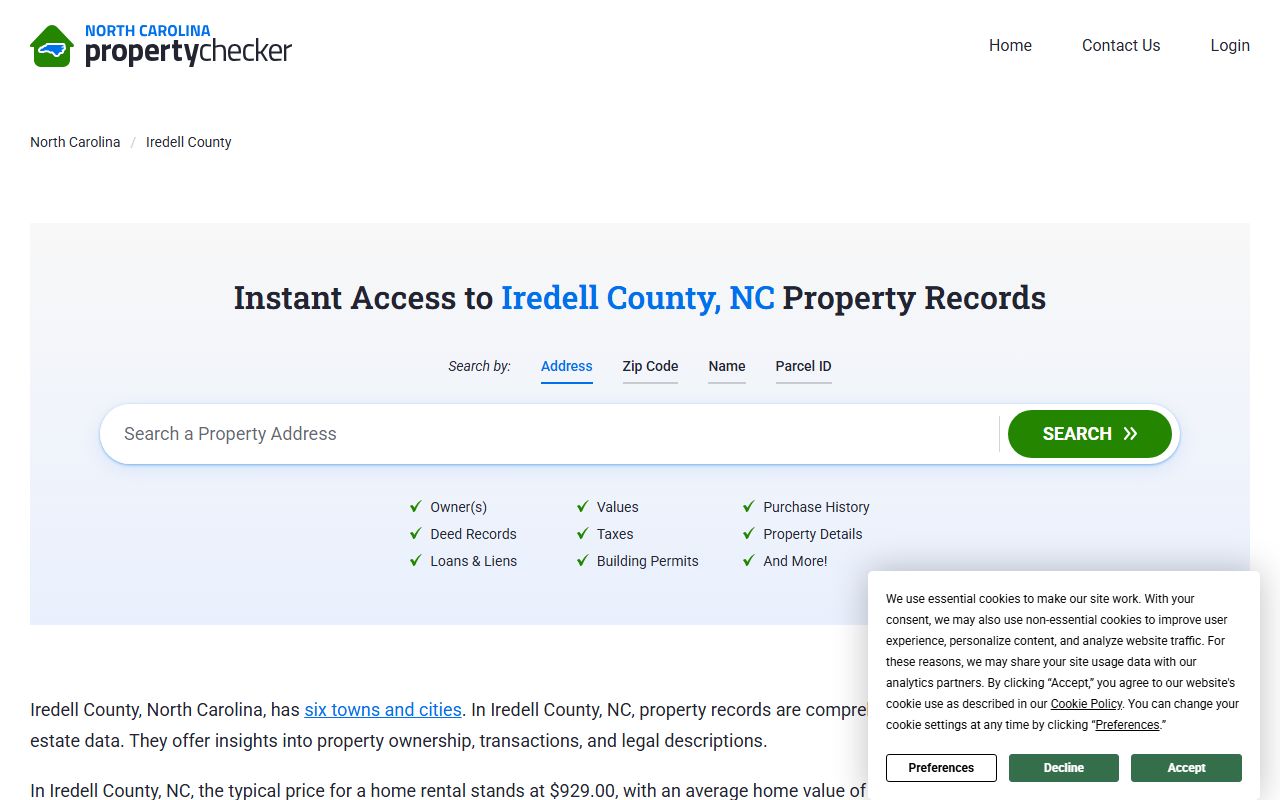
Online results are for reference. Official copies come from the Register of Deeds office in Statesville.
Iredell County Courthouse Fire of 1854
The Iredell County courthouse burned in 1854. This fire destroyed some early records. The FamilySearch genealogy guide notes this event. Researchers looking for records from before 1854 may find gaps in the collection.
Despite the fire, the State Archives holds court records from 1788 to 1909, divorce records from 1855 to 1934, and marriage records from 1788 to 1868. Wills from 1787 to 1917 are also at the State Archives. These backup sources can fill in some of the gaps left by the 1854 fire. Iredell County deed records from after the fire are complete and well-maintained.
Recording Fees in Iredell County
Iredell County recording fees follow the statewide schedule. Under G.S. 161-10, most instruments cost $26 for the first 15 pages and $4 per extra page. Deeds of trust and mortgages are $64 for the first 35 pages plus $4 per page after that.
Nonstandard documents get a $25 surcharge. Plats cost $21 per sheet. Satisfaction instruments have no fee. The NCARD fee schedule shows all current rates. Under G.S. 105-228.30, the excise tax on property transfers is $1 per $500 of the sale price. The seller pays this before the Register of Deeds records the deed.
How to Record a Deed in Iredell County
Recording a deed in Iredell County requires careful preparation. The deed must be signed by the grantor. A notary or authorized officer must acknowledge the signature per G.S. 47-14. The document must meet format rules from G.S. 161-14.
Format rules for Iredell County deed records are the same as statewide. Use 8.5 by 11 or 8.5 by 14 inch paper. Leave a 3-inch top margin on the first page. All other margins must be at least half an inch. Text goes in black ink on white paper. Font size must be 9 points or larger. Print on one side only. Name the instrument at the top of the first page.
Bring the deed to 201 E. Water Street in Statesville. Pay fees and excise tax. The register records it with a date and time stamp. North Carolina's race to record rule under G.S. 47-18 gives priority to whoever files first. Record your Iredell County deed as soon as you can after closing.
Iredell County Genealogy Research
Iredell County deed records are a strong tool for genealogy. Land records from 1788 can show early family settlements and property transfers between generations. The State Archives holds wills from 1787. These complement the deed record collection for researchers tracing family history in the Statesville area.
The FamilySearch guide lists additional resources for Iredell County research. Court records, divorce records, and marriage records at the State Archives fill in details beyond what the Register of Deeds holds. The NCARD directory helps you find other county offices if your research crosses into neighboring counties.
Iredell County deed records are especially important for the Mooresville and Lake Norman areas, where real estate growth has been strong for years. Each new home sale, lot split, and loan adds to the total volume of filings at the Hall of Justice Annex. The 1854 courthouse fire makes pre-fire deed research harder, but the State Archives in Raleigh holds court records from 1788 and wills from 1787 that can fill some gaps. Title searchers in Iredell County should check both the local office and the State Archives when the chain of title runs back past the mid-1800s. The state excise tax of $1 per $500 of sale price applies to all Iredell County deed transfers, and the seller must pay it at the time of recording.
The NC Secretary of State administers the land records management program. This program ensures uniform indexing across all counties. The North Carolina Association of Registers of Deeds supports every county with resources and guidance.
The image below shows the Conner Act statute that applies to Iredell County deed priority.
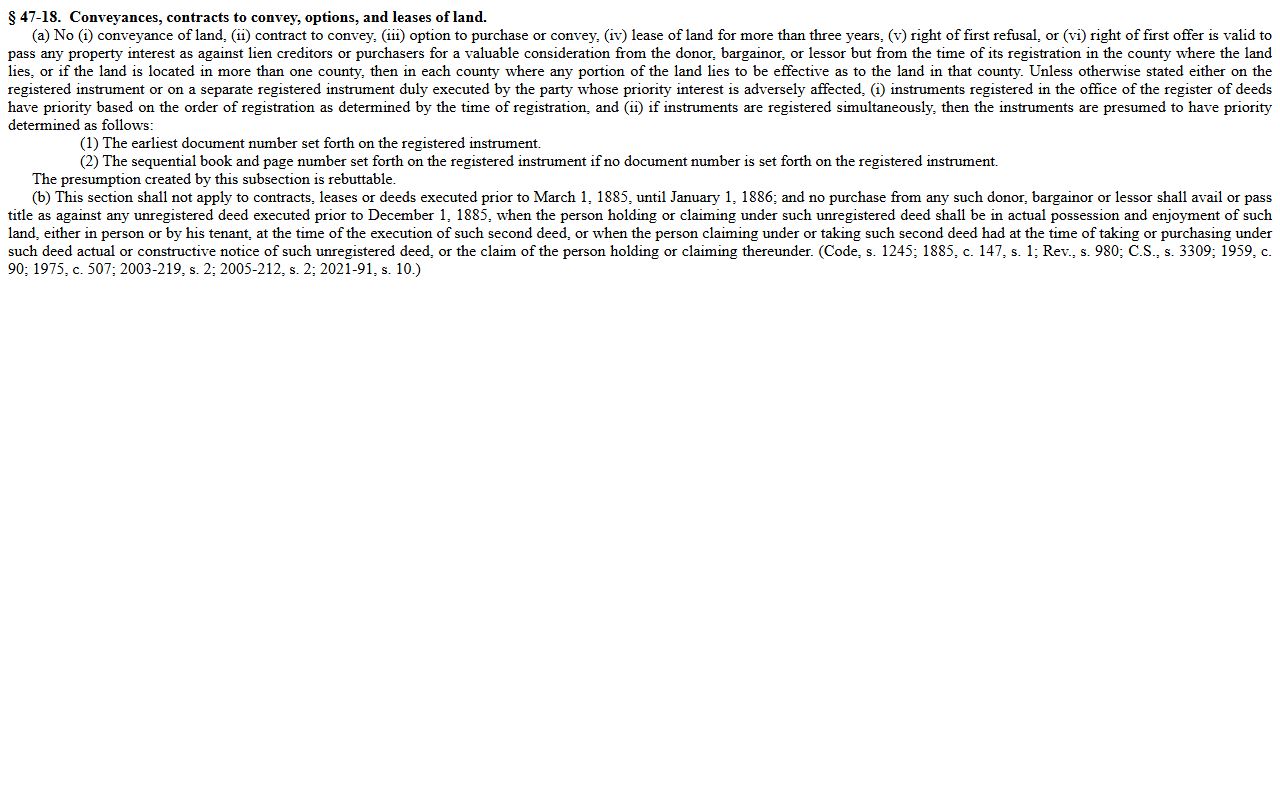
This law protects buyers who record their deeds first.
Nearby Counties
Iredell County is in the western Piedmont of North Carolina. These neighboring counties also maintain deed records through their Register of Deeds offices.