
Gaston County Property Deeds
Gaston County deed records start in 1845 and run to the present day. The Register of Deeds office in the Gaston County Courthouse in Gastonia serves as the official keeper of all deeds, deeds of trust, plats, and liens. Jonathan Fletcher serves as Register of Deeds, elected for a four-year term. Prior to 1845, Gaston County records were part of Lincoln County. The office provides a safe place for all documents that affect property or personal status. You can search these records online or visit the courthouse on North Marietta Street during regular hours.
Gaston County Deed Records Quick Facts
Gaston County Register of Deeds Office
The Gaston County Register of Deeds is on the 1st Floor of the Gaston County Courthouse at 325 North Marietta Street, Gastonia, NC 28052. The main phone number is (704) 862-7680. The Deed Room can be reached at (704) 862-7684. Register Jonathan Fletcher oversees the office and staff.
The office provides a proper and safe repository for deeds and other documents that affect property. It records deeds, deeds of trust, plats, liens, assumed names, and other land instruments. The Gaston County Register of Deeds page has full contact details and service descriptions.
The Gaston County Register of Deeds office page is shown below.
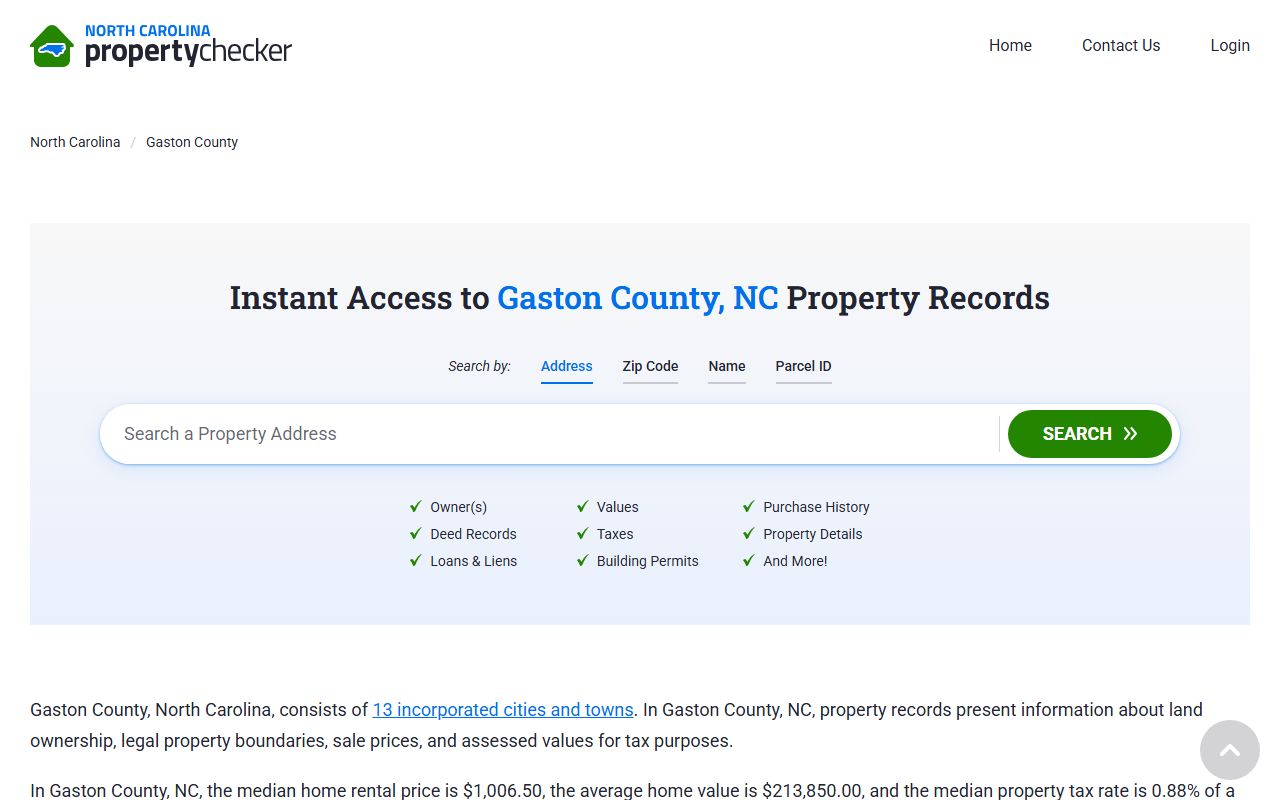
Visit this page for the latest hours, services, and contact information for the Gaston County deed office.
Searching Gaston County Deed Records
You can search Gaston County deed records online through the Register of Deeds website. The online deed search covers records from 1845 to the present. Search by name, book and page, or document type. If you cannot find a record by page, try searching by book number only.
Digital images of Gaston County deeds from 1847 to 1961 are also available on FamilySearch.org. The Gaston County Public Library research guide has tips for finding property records, including state grant records from 1845 to 1891 and plat books from 1913 to 1964. Microfilm copies are on file at the library as well.
For records before 1845, check Lincoln County. Gaston County was formed from Lincoln in that year.
Gaston County Recording Fees
Recording fees in Gaston County follow the statewide schedule under G.S. Chapter 161. A standard deed is $26 for the first 15 pages, with $4 for each extra page. Deeds of trust and mortgages cost $64 for the first 35 pages. Nonstandard documents add $25 to the total. Plats cost $21 per sheet. Satisfaction instruments are filed for free.
The NCARD recording fees page has the full fee schedule for all instruments.
The North Carolina recording fee schedule is shown below.
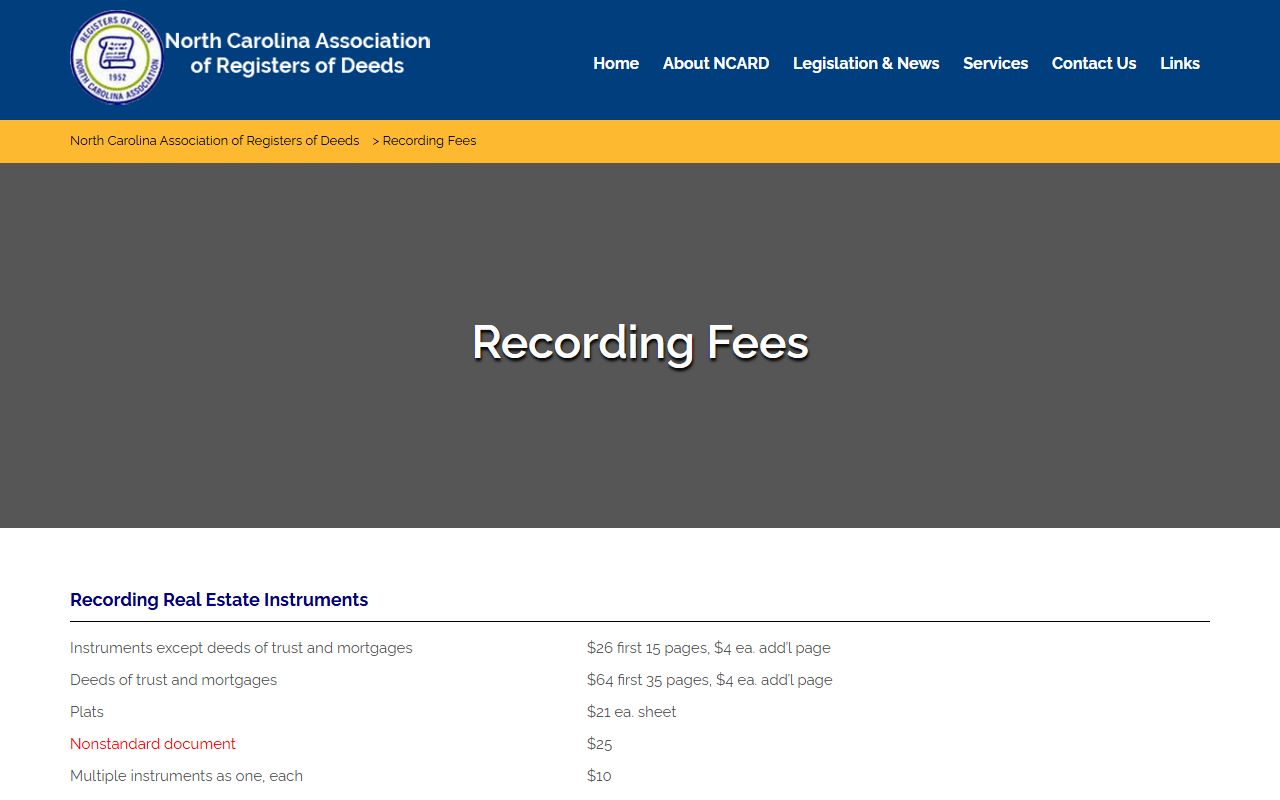
These fees apply to all documents filed with the Gaston County Register of Deeds.
Gaston County and the Conner Act
North Carolina is a race to record state. Under the Conner Act, G.S. 47-18, the first person to record a deed at the Gaston County Register of Deeds holds the legal claim. A deed that sits unrecorded is not valid against a later buyer who files first.
The register stamps each document with the date and time of filing. This stamp sets the priority order. If two documents arrive at the same moment, the one with the lower document number takes priority. The rule applies to deeds, options, leases over three years, and rights of first refusal. Quick filing protects your interest in any Gaston County land deal.
Excise Tax on Gaston County Transfers
Every deed that conveys real property in Gaston County carries an excise tax. Under G.S. 105-228.30, the rate is $1 per $500 of the sale price. The seller pays this tax to the Register of Deeds before the deed is filed. Timber deeds are taxed the same way.
If the parcel sits in two or more counties, the tax goes to the county with the larger share of value. The excise amount is noted on the recorded deed.
Gaston County Document Format Rules
All deeds filed in Gaston County must meet format rules under G.S. 161-14. Paper must be 8.5 by 11 inches or 8.5 by 14 inches. The first page needs a 3-inch top margin. Other margins must be at least half an inch. Text must be in black ink on white paper. The font must be 9 points or larger. Only one side of each page may have text. The instrument type must appear at the top of the first page.
The drafter's name is required on the first page for all deeds executed after January 1, 1980, under G.S. 47-17.1. Each deed must be signed, notarized, and acknowledged before the register will accept it. Nonstandard documents that fail to meet these rules carry a $25 surcharge on top of the base recording fee.
Gaston County Historical Deed Records
Gaston County was created from Lincoln County in 1845. Original deeds date from that year. For property that changed hands before 1845, Lincoln County holds the earlier records. State grant records from 1845 to 1891 are part of the Gaston County archive. Plat books cover 1913 through 1964.
Older deed records may contain handwritten text with old place names. Staff at the Register of Deeds can help you read and find early documents. The NCARD directory lists contact details for every county Register of Deeds in North Carolina. This can help if your title search leads to records in Lincoln County or another nearby county.
The Secretary of State administers the land records management program for all 100 counties. This program helps maintain uniform standards and indexing across the state, including Gaston County.
Under G.S. 161-22, the register keeps full alphabetical indexes for all recorded instruments. These indexes list every party to each deed, grant, mortgage, or other instrument. Cross-indexing means you can search by grantor or grantee. The index notes the book and page for each entry so you can find the full document quickly.
Nearby Counties
Property searches near Gaston County may also involve deed records from these neighboring offices.