
Duplin County Property Deed Records
Duplin County holds some of the oldest deed records in North Carolina. The earliest land documents date back to 1749, making the county archive a rich source for property research and title work. The Register of Deeds office in Kenansville manages all deed records for the county. These include deeds, deeds of trust, plats, and liens. The office also stores birth, death, and marriage records. All deed records are public and open for review. You can search them in person at the courthouse or request copies by mail.
Duplin County Deed Records Quick Facts
Duplin County Register of Deeds Office
The Duplin County Register of Deeds is at 118 Duplin Street in the Courthouse Annex, Room 106, in Kenansville, NC 28349. The mailing address is Post Office Box 970, Kenansville, NC 28349. Office hours run from 8:00 a.m. to 5:00 p.m., Monday through Friday. All deed records kept by this office are public records. The only exception is military discharge documents, which have limited access. Military discharge records must be on file for 80 or more years before the public can view them.
The Duplin County record system is name-based. You search by the name of the grantor or grantee. If you need to look up a property by address, contact the GIS Department at 910-296-2110. Staff at the Register of Deeds can help you find deeds, liens, plats, and other land documents.
The Duplin County Register of Deeds office provides access to property records and vital record services, as shown below.
Use this portal to learn about available services and access deed record search tools for Duplin County.
Searching Duplin County Deed Records
To search deed records in Duplin County, start with the name of the buyer or seller. The index is set up by name, not by address. Enter a last name first, then a first name. Short searches tend to work best. You can narrow results by date range or document type.
Duplin County deed records go back to 1749. Older records may use different spelling or names. If you cannot find a record, try alternate spellings. Staff at the office can also help with hard-to-find documents. Copies of deeds are available in person or by mail.
The NCARD directory lists contact details for the Duplin County Register of Deeds and all other counties in the state.
Recording Fees in Duplin County
Duplin County follows the statewide fee schedule set by G.S. Chapter 161. A standard deed costs $26 for the first 15 pages. Each page after that adds $4. Deeds of trust and mortgages cost $64 for the first 35 pages, plus $4 per extra page. If a document does not meet format standards, a $25 nonstandard fee applies on top of the base cost. Satisfaction instruments are filed at no charge.
The NCARD recording fees page has a full list of current fees. Plats cost $21 per sheet. If multiple instruments are filed as one, each one adds $10 to the total.
The statewide recording fee schedule from the North Carolina Association of Registers of Deeds is shown below.
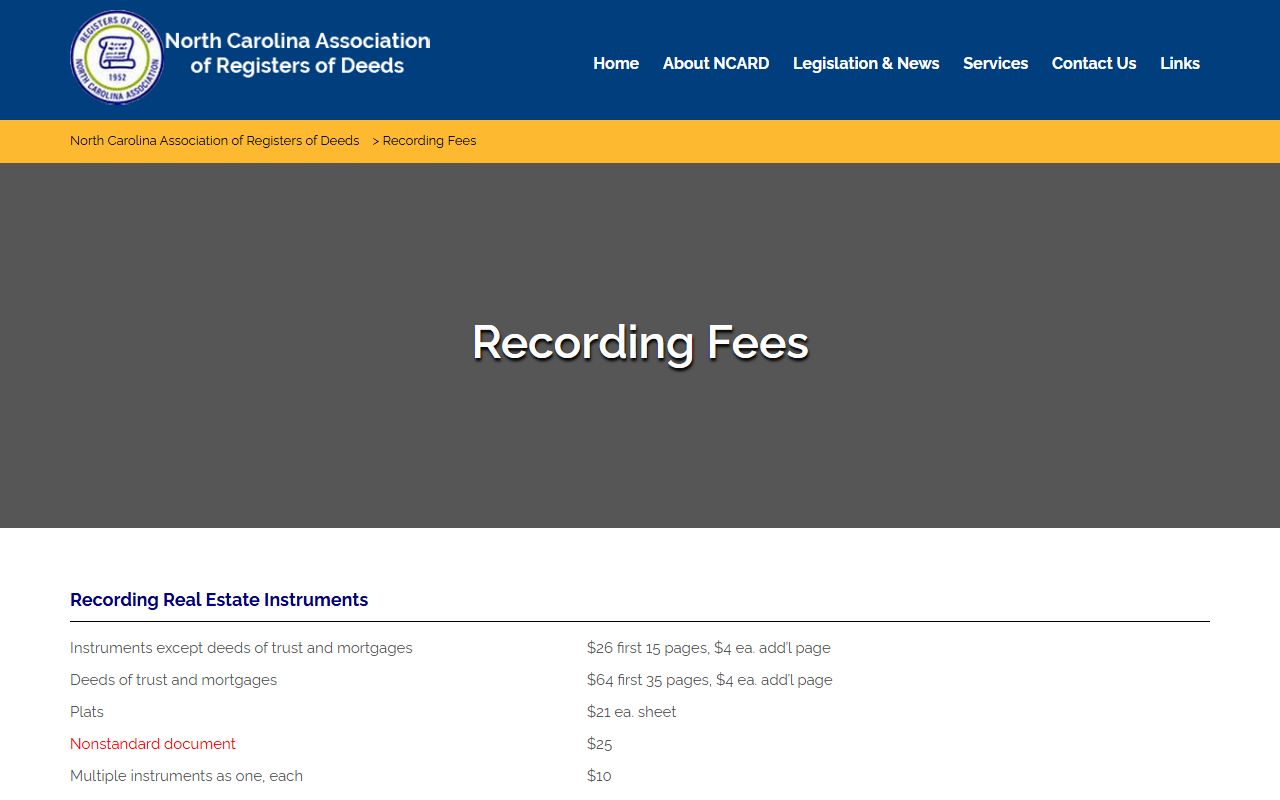
These fees apply to all documents filed with the Duplin County Register of Deeds.
Duplin County Deed Records and State Law
North Carolina is a race to record state. Under the Conner Act, G.S. 47-18, no deed is valid against a later buyer who records first. This means the person who files a deed at the Duplin County Register of Deeds before anyone else holds the legal claim. Priority depends on the time the document is stamped by the register.
If two deeds are filed at the same time, the one with the lower document number takes priority. This rule protects buyers across the state. It also makes prompt recording a key step in any land deal.
All documents must meet the format rules in G.S. 161-14. Paper size must be 8.5 by 11 inches or 8.5 by 14 inches. The first page needs a 3-inch top margin. Other margins must be at least half an inch. Text must be in black ink on white paper, in a font of 9 points or larger. Only one side of each page should have text.
Excise Tax on Duplin County Property Transfers
When property changes hands in Duplin County, the state imposes an excise tax. The rate is $1 for every $500 of the sale price, as set by G.S. 105-228.30. The seller pays this tax to the Register of Deeds before the deed is filed. Duplin County has applied the real estate excise tax at $2 per thousand since August 1, 1991.
Timber deeds and contracts for standing timber are taxed the same way. If a parcel spans two or more counties, the tax goes to the county where the greater share of value lies.
Duplin County Historical Land Records
Duplin County has land records dating to 1749. These early deeds cover some of the oldest settled areas in eastern North Carolina. Marriage certificates in Duplin County date from 1869, and the bond book goes back to 1779. Birth and death records begin in October 1913.
Older deed records may use handwritten entries with old place names. Some names may not match current maps. Staff at the Register of Deeds office can help you read and locate these documents. The North Carolina Association of Registers of Deeds serves all 100 counties and can help connect you with local resources.
The Conner Act and its impact on deed recording priority in North Carolina is outlined in the document shown below.
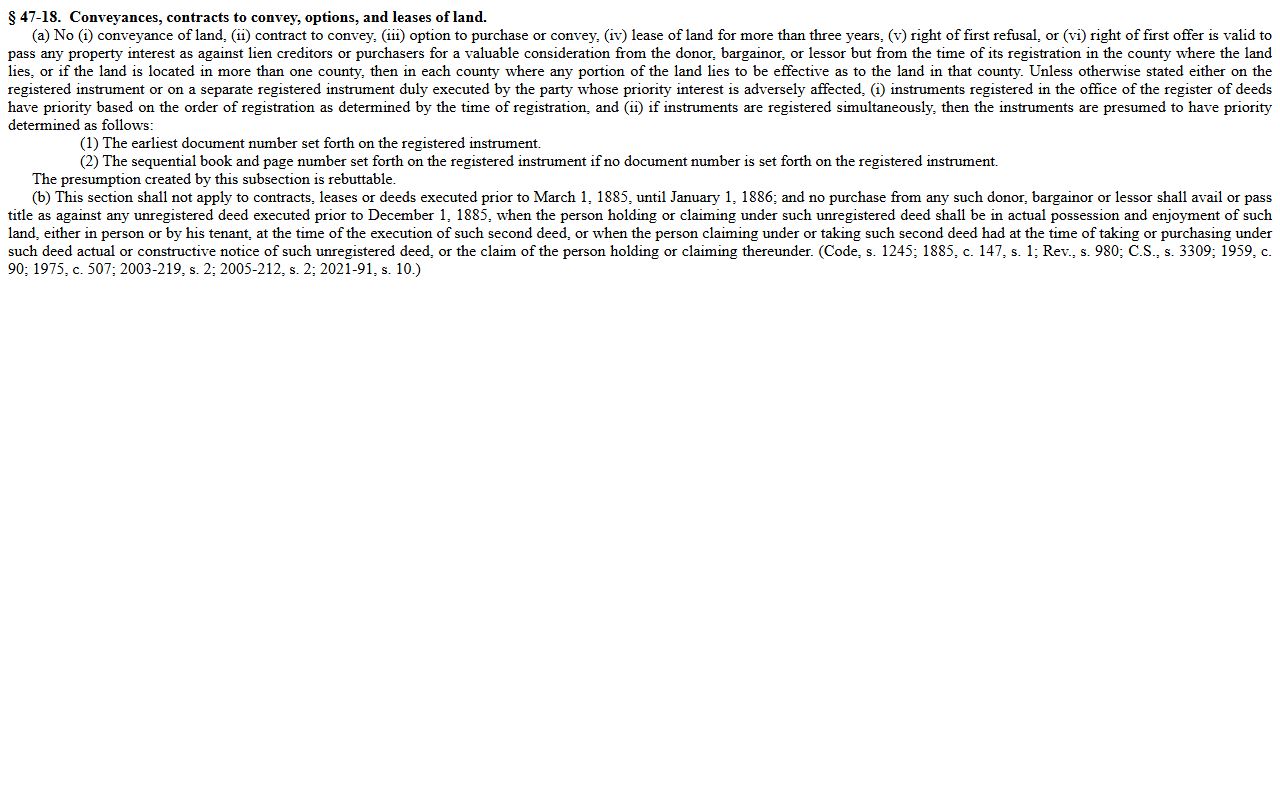
This statute governs the priority of deed records in Duplin County and all other North Carolina counties.
Document Standards for Duplin County
Every deed filed in Duplin County must meet state format rules. The type of instrument must appear at the top of the first page. The drafter's name must also be on the first page for deeds executed after January 1, 1980, as required by G.S. 47-17.1. Each deed must be signed, notarized, and acknowledged before the register will accept it.
The North Carolina Secretary of State oversees the Electronic Recording Council. This council sets standards for eRecording across the state. Duplin County follows all statewide rules for both paper and electronic filings.
Under G.S. 161-31, the board of commissioners in any county can require tax certification before a deed is recorded. A closing attorney can bypass this step by including a statement that delinquent taxes will be paid from closing proceeds.
Nearby Counties
If your property search extends beyond Duplin County, these nearby offices may hold related deed records.