
Durham NC Property Deed Records
Durham deed records are maintained by the Durham County Register of Deeds. The city of Durham is both the county seat and the largest city in Durham County. All property deeds, liens, trust documents, and land filings for Durham go through the county register of deeds office. The city does not record deeds or keep land records. Durham County provides online search tools and in-person services for anyone who needs to access Durham deed records, from homebuyers to title researchers.
Durham Deed Records Quick Facts
Durham Deed Records Overview
The Durham County Register of Deeds is the only office that records Durham deed records. North Carolina law assigns this duty to the county level. Each of the state's 100 counties has a register of deeds elected to a four-year term under G.S. 161-2. The Durham County register handles all land records, property transactions, and vital records for the city.
The City of Durham offers many services to residents, including water management, newsletters, and service requests at 919-560-1200. But deed records are not among them. For any property filing or deed search, you must go through Durham County.
The image below shows the City of Durham official website.
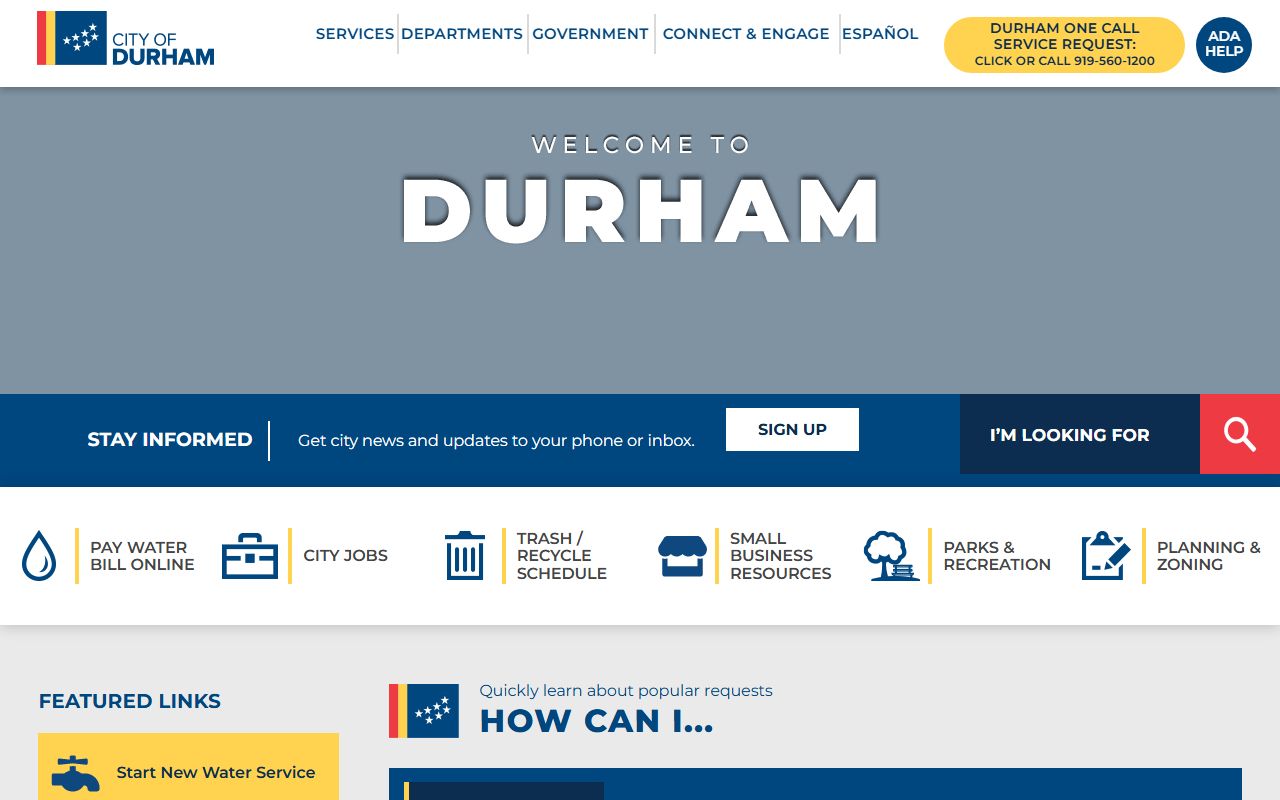
The city site can help with many local matters but not deed recordings.
Searching Durham Property Deeds
Durham County offers several ways to search deed records. The Durham County Property Record Search on the Spatialest platform gives access to detailed property information. You can look up parcels by owner name, address, or block number. The system includes historical records from old large map books that date back to 1952 and were updated until 1988.
A block search shows the map books for a given area. Parcel ownership data is maintained in the Owner Ledger, which covers records from 1988 through 2004. For more recent Durham deed records, the county's online land records system provides current data. The Durham County government website has links to all departments and services.
The register of deeds keeps full alphabetical indexes of all recorded instruments. Under G.S. 161-22, these indexes must list the names of all parties to every deed, mortgage, bond, and other registered instrument. Cross-indexing ensures that Durham deed records can be found by either party's name.
Durham Deed Recording Costs
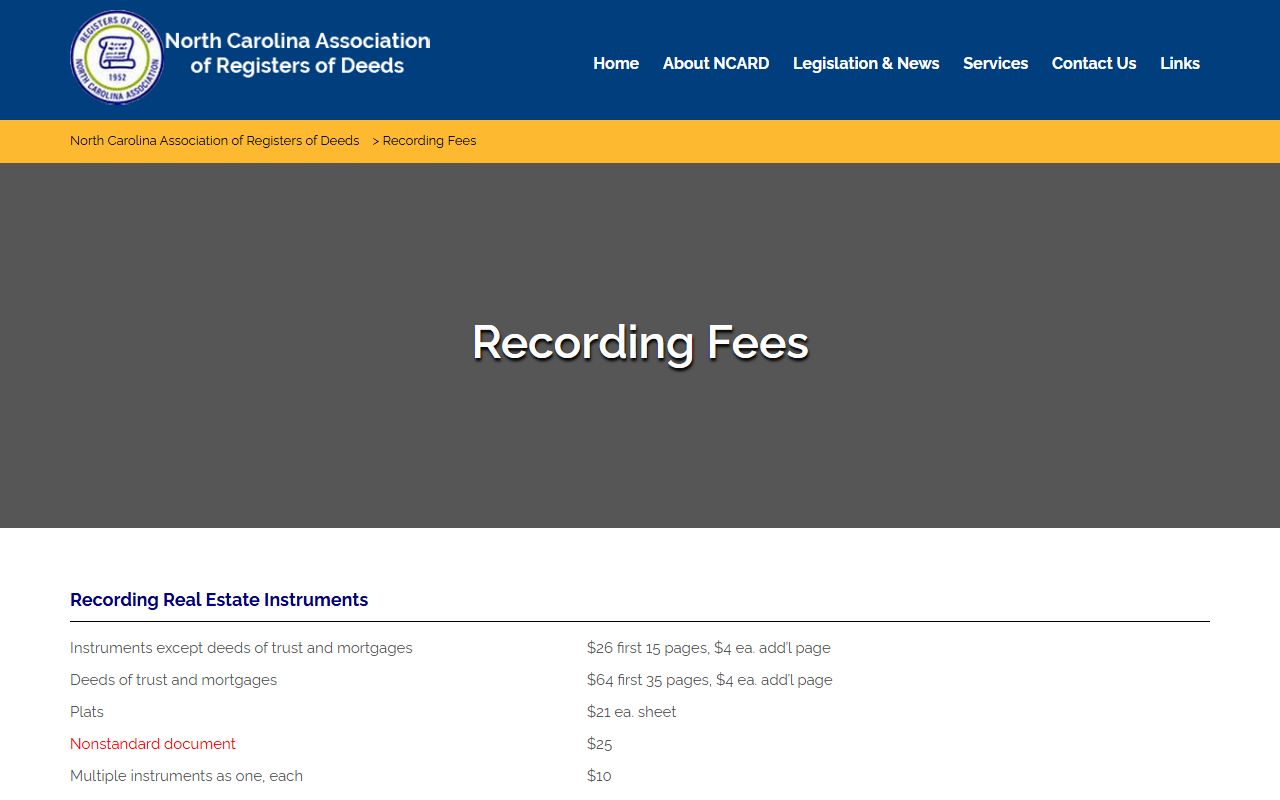
Durham deed records follow the statewide fee schedule set by G.S. 161-10. The NCARD recording fees page shows all current rates. Standard deeds cost $26 for the first 15 pages and $4 per page after that. Trust deeds and mortgages cost $64 for the first 35 pages with $4 per added page.
Plats cost $21 per sheet. A nonstandard document adds $25 to the base fee. Satisfaction instruments have no recording fee. Multiple instruments filed as one document cost $10 each. These fees are uniform across all North Carolina counties, so Durham deed costs are the same as in any other part of the state.
Durham Deed Priority Law
North Carolina follows a "race to record" rule for Durham deed records. The Conner Act at G.S. 47-18 says no conveyance of land is valid against a buyer for value until it is registered in the county where the land lies. For Durham properties, that means Durham County. The first party to record a deed holds legal priority.
If two instruments are filed at the same time, the one with the earliest document number has priority. If no document number is assigned, the sequential book and page number controls. This system rewards prompt filing. Durham property buyers should make sure their attorney records the deed right after closing.
Durham Deed Format Rules
All Durham deed records must meet format standards before the county will accept them. Under G.S. 161-14, each document must be on 8.5 by 11 inch or 8.5 by 14 inch paper. A three-inch blank margin is required at the top of the first page. Other margins need at least half an inch. Text must be typed or printed in black on white paper with a minimum font of 9 points. Printing goes on one side only.
The instrument type must appear at the top of the first page. For deeds drafted after January 1, 1980, the name of the person who prepared the document must be shown on page one. Failure to comply with these rules results in a $25 nonstandard document surcharge on top of the normal Durham deed recording fee.
Durham Transfer Tax on Property
An excise tax applies to each Durham deed that transfers property for value. G.S. 105-228.30 sets the rate at $1 for every $500 of the purchase price or any part of that amount. The seller pays this tax to the Durham County Register of Deeds before recording. On a $375,000 Durham home, the excise tax is $750.
This fee schedule from NCARD applies to all Durham deed recordings.
The excise tax also covers timber deeds and standing timber contracts. It applies to every conveyance of real property in Durham.
Durham Electronic Deed Filing
Many North Carolina counties now accept electronic deed filings. The NC Secretary of State oversees the Electronic Recording Council. Under the Uniform Real Property Electronic Recording Act, electronic documents, electronic signatures, and electronic notarization are all valid for recording. The NCARD website lists which counties support eRecording.
The NCARD directory provides contact information for every county register of deeds in North Carolina. Each listing shows whether the county supports eRecording, eBirth registration, and property fraud detection alerts. Check the Durham County listing for the latest on electronic filing options.
Durham County Deed Records
All Durham deed records are filed and maintained by the Durham County Register of Deeds. The county office handles every property recording for the city of Durham. Visit the county page for full details on the register of deeds office, online property search tools, and recording procedures.